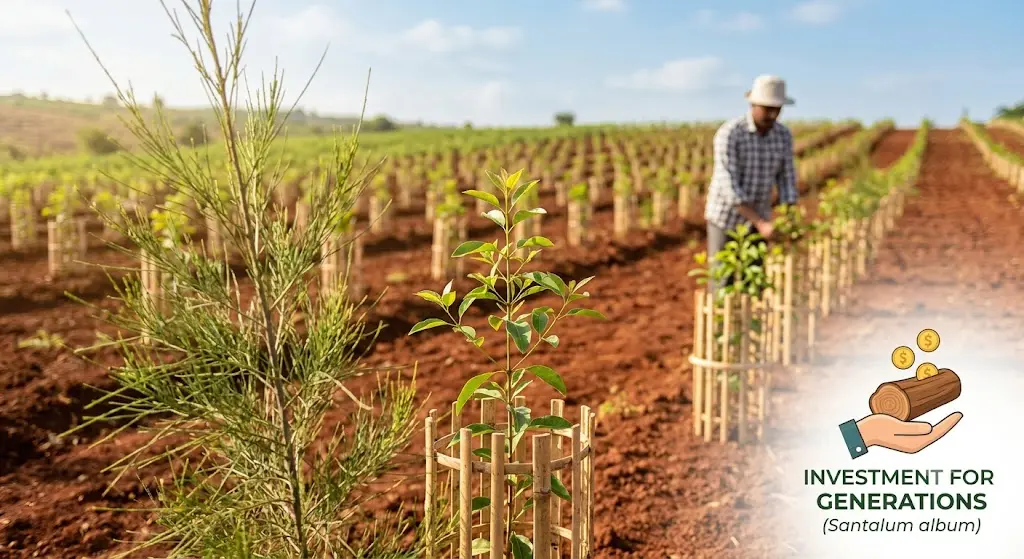
Quick answer: White Sandalwood takes part of its water and nutrients from the roots of plants growing beside it, so it needs living host plants. Plant them 2–3 months before the sandalwood seedlings. Red Sandalwood does not need them.
Primary hosts to plant first
- Tephrosia purpurea: the best primary host, and it fixes nitrogen
- Cassia siamea: an excellent secondary host that grows fast
- Casuarina equisetifolia: a strong host that also works as a windbreak
- Neem (Azadirachta indica): a hardy perennial host that keeps pests away
Secondary and companion hosts
| Host | Why farmers use it |
| Pongamia pinnata | A good host, plus oil seeds |
| Cajanus cajan (pigeon pea) | An annual host and a food crop |
| Groundnut (Arachis) | An annual host between the rows |
| Acacia nilotica (babool) | A hardy nitrogen-fixing host for dry areas |
Spacing and timing
- Plant 3 hosts 1–2 m from each sandalwood pit.
- Plant them 2–3 months before transplanting the sandalwood.
- Replace a dead host within 2 weeks.
- Keep 1–2 living hosts beside every tree at all times.
What not to plant
Do not plant Eucalyptus near sandalwood: it competes aggressively.
Host diversity reduces the risk of losing every host at once.
Red Sandalwood is different
Red Sandalwood (Pterocarpus santalinus) does not need host plants, so skip this step if that is what you are growing. For the whole planting sequence, see our farming guide.