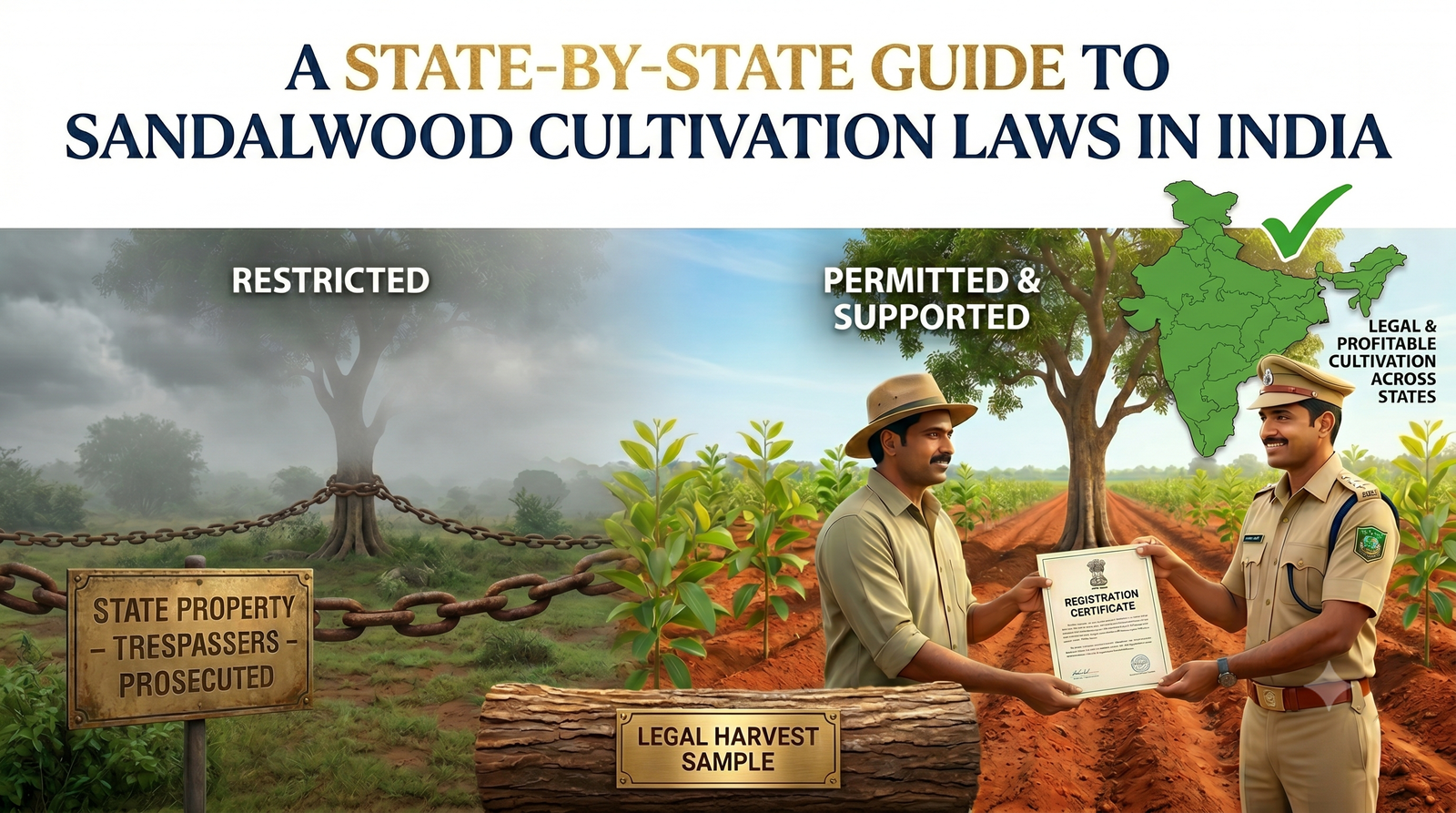
A State-by-State Guide to Sandalwood Cultivation Laws in India:
If you are thinking about growing sandalwood (Santalum album) on your land, the very first question that comes to mind is usually this: "Is it legal? Can I grow sandalwood on my own farm? And what are the rules when it comes to selling it?"
This is a completely fair and crucial question. For a long time in India, sandalwood was governed by incredibly strict colonial-era laws. They were so strict that even if a sandalwood tree naturally grew on your own private land, it was considered government property. You could not cut it. You could not sell it. The state owned it.
But things have changed dramatically over the last two decades. Today, farmers across India can legally grow sandalwood on their own land, harvest it, and sell it—as long as they follow the correct, defined process.
In this comprehensive guide, we will walk you through exactly what the law says in each major state, in plain, simple language, so that you can begin your plantation with confidence.

The History: Why Were the Old Laws So Strict?
After Independence, the Indian government treated sandalwood as a precious, near-extinct forest resource that needed absolute protection. Following colonial precedent, all sandalwood trees, even those growing on private farmland (patta land), were declared state property. The individual farmer was essentially just a caretaker.
The result? Farmers had no incentive to grow sandalwood. Why would you plant and protect a tree that belongs to the government? Consequently, nobody planted new trees. Instead, natural forests got heavily poached by timber mafias (like the infamous Veerappan), the supply fell sharply, and prices shot up.
By the late 1990s, the government realized that this restrictive model had failed. The only way to protect sandalwood in the long run was to give farmers a direct stake in growing it. If farmers could profit from sandalwood, they would protect it, and the pressure on wild forests would reduce.
So, starting from 2001 and 2002, states began changing their laws one by one. Today, private sandalwood farming and commercial cultivation are actively encouraged across most of India.
The 4 Universal Rules of Legal Sandalwood Farming:
Before we dive into state-specific regulations, it is critical to understand the four core principles that apply almost everywhere in India. Master these four rules, and you will understand 80% of the legal landscape.
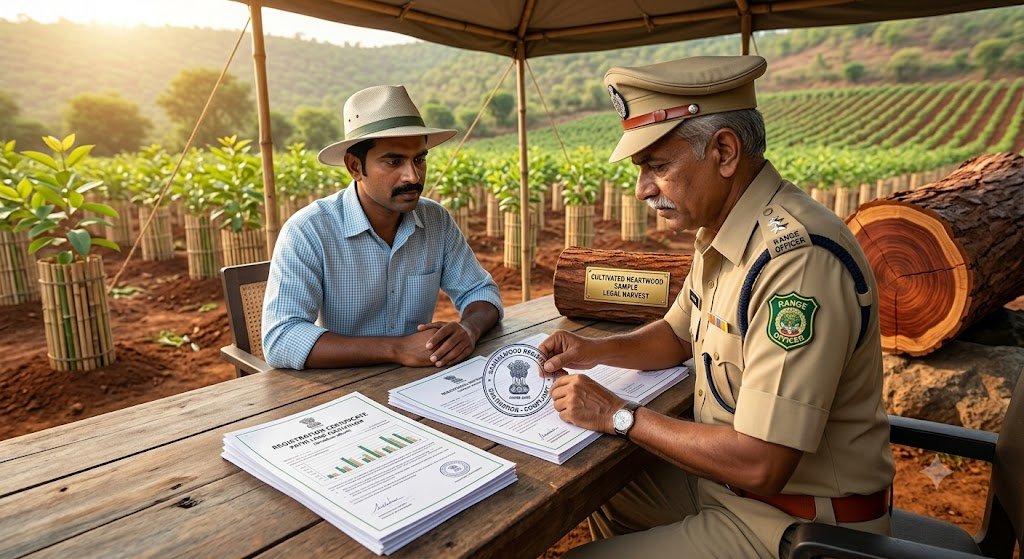
Rule 1 — Planting is Free You can plant sandalwood seedlings on your own registered agricultural land (patta land) without taking any prior special permission. If the land is yours and it's classified as agricultural, you are free to plant.
Rule 2 — Registration is Non-Negotiable Once your trees are established and growing, you must register them with your state's Forest Department (usually at the Range Office level). This registration is your legal proof of ownership. Without it, your trees may be considered government property, and you have no legal protection. This is the single most important step for legal compliance.
Rule 3 — You cannot Cut Without Government Permission. When your trees mature (after 15–20 years), and you want to harvest them, you must apply for a formal felling permit from the Forest Department. A Forest Range Officer must inspect the site and be present during the actual harvesting process. No permit means no cutting, even if the tree is on your private land.
Rule 4 — Selling and Transport Require Documentation When you sell your sandalwood or transport it from the farm to a factory or market, you need proper paperwork, specifically a Transit Pass (TP). Selling or moving the wood without these documents is illegal and can lead to seizure by authorities, even if the wood was grown perfectly legally.
State-by-State Guide to Sandalwood Cultivation Laws:
Now, let us look at the specific legal frameworks in major Indian states where sandalwood cultivation is prominent.
Karnataka — The Most Farmer-Friendly State:
Karnataka is the historical heartland of Indian sandalwood, accounting for nearly 60% of India's natural sandalwood population. The Deccan Plateau's soil, rainfall, and climate are ideal for Santalum album.
What the law says:
✅ You can plant sandalwood on your private patta land without prior permission.
✅ Registration with the Forest Department is compulsory.
✅ For harvesting, you must obtain a felling permit.
✅ For transport and sale, a transit pass is required.
The Major Policy Shift (2022): This was a major turning point for Karnataka farmers. The state government passed new rules allowing farmers to sell their sandalwood to any buyer of their choice—not just the government. This opened up the free market for the first time. Farmers can now negotiate prices with private cosmetic companies, perfume manufacturers, and international traders freely.
Government Support: Karnataka has launched schemes like Sirichandana Vana and Krishi Aranya Yojana, under which farmers can get sandalwood seedlings at subsidized rates from the horticulture department.
A Word of Caution: Theft Sandalwood theft remains a serious issue. While the government is developing GPS-based tree tracking solutions, farmers must invest in their own protection (security, fencing) for mature trees.
Andhra Pradesh — Clear Ownership, Structured Process:
Andhra Pradesh is home to both highly valuable white sandalwood and the globally demanded Red Sanders (red sandalwood). The state has a well-defined legal process for private farming.
What the law says:
✅ Cultivation is permitted only on privately owned patta land with a proper title document.
✅ The entire activity is governed by the Andhra Pradesh Forest Act, 1967.
✅ Before planting, register your plantation with the Forest Department. There is usually a nominal fee per tree.
✅ Harvesting and transport require prior permits.
✅ Selling outside the legal framework can lead to serious legal consequences and seizure.
Farmer Benefits: The AP government has focused on streamlining ownership, making it clear that trees on private land belong to the farmer. This clarity makes it a very appealing state for long-term investors.
Tamil Nadu — Mandatory Registration with Government Support:
Tamil Nadu also moved to make private sandalwood farming legal in 2002. Since then, it has gradually refined its processes to become more farmer-friendly.
What the law says:
✅ Governed by the Tamil Nadu Forest Act, 1882.
✅ Plantation registration and official tree marking (numbering) with the Forest Department are compulsory.
✅ Harvesting and trade are highly regulated, requiring specific permits.
Farmer-Friendly Aspects: The state has simplified its registration process in recent years and actively provides technical assistance. Farmers can get guidance on soil testing, selecting appropriate host plants (crucial for sandalwood growth), and managing common diseases like spike disease.
Kerala — Focus on Extension Services and Training:
Kerala's sandalwood regulations are governed by the Kerala Forest Act, 1961.
What the law says:
✅ Cultivation, harvesting, and transport are all strictly regulated.
✅ Special permits are mandatory for both felling and transporting the wood.
✅ Regular Forest Department inspections are common, and detailed tree records are maintained.
Farmer-Friendly Aspects: Kerala is arguably the most proactive state regarding farmer training. The Forest Department regularly conducts workshops focused on maximizing heartwood yield, managing diseases, and modern cultivation techniques.
Maharashtra — Ownership Rights Being Strengthened:
Maharashtra is a newer entrant to the sandalwood farming space, but the state has been moving toward encouraging private plantations.
What the law says:
✅ Governed by the Maharashtra Forest Manual.
✅ Compulsory registration of your plantation with the state forest authorities.
✅ Harvesting and sale require prior government permission.
Best Regions: Farmers in parts of Marathwada and some areas of Vidarbha have suitable soil conditions (rocky, well-drained soils with moderate rainfall). However, the overall framework and government support systems are less mature than those in the southern states. If you are starting here, be extra meticulous about all documentation.
Rajasthan and Madhya Pradesh — The New Frontiers:
Sandalwood farming is technically possible and growing in parts of Rajasthan and Madhya Pradesh, especially in areas with suitable climates. Small-scale plantations are emerging.
The Current Status: The state-level legal framework is not yet as clearly defined or as streamlined as in states with dedicated sandalwood acts. The Central Indian Forest Act rules often apply, but state-level incentives are limited.
Our Advice: Before you plant, visit your District Forest Officer (DFO) and get clarity, in writing, about the exact registration process and what documents will be required. Get official confirmation before making a major investment.
What Documents Should You Keep Ready?
Whether you are in Karnataka or Tamil Nadu, Andhra Pradesh, Rajasthan, Maharashtra, or any other state of India, keep these documents safe at all times:
✅ Land ownership papers (patta, khatauni, or equivalent title document)
✅ Plantation registration certificate from the Forest Department
✅ Tree registration records (number of trees, location, date of planting)
✅ Felling permit (when you harvest)
✅ Transit pass (when you transport the wood)
✅ Sale receipts and buyer documentation
These documents are your protection. A farmer with clean paperwork has nothing to fear from any inspection.
We have compiled the actual government orders, state forest acts, and official notifications for each state in one place — visit our Government Laws & Notifications page to read or download them for your reference.
Conclusion: Can You Start Right Now?
The answer is Yes — and the timing is actually excellent. Sandalwood prices continue to rise, and governments across India actively want more farmers to cultivate it on private land to meet global demand legally. The legal process is not complicated once you understand the core requirements.
The only farmers who face legal problems are those who attempt to skip the paperwork: those who plant without registering or try to harvest/sell without permits. Those shortcuts are simply not worth the risk.
✅ Make sure your land papers are in order (patta, khatauni)
✅ Visit your district's Forest Department or DFO office — ask about the local registration process
✅ Get good-quality certified seedlings from a government nursery or a reputed source
✅ Plant with proper host plants — this is crucial for growth
✅ Register every tree as soon as you plant
✅ Keep all your records updated year by year
✅ Never harvest without a permit — no matter what
Grow it right. Document it well. And you will have one of the most valuable crops in India standing on your land.
Have questions about the rules in your state? Write to us at info@sandalwoodindia.com